Skip to content

Art Cart

April 15, 2013

The D-School (Institute of Design at Stanford) pride’s itself on a napkin sized manifesto, with a simple, but grand objective written in bold black letters “Create the best design school ever. Period.”  The napkin goes on to list how to achieve this goal: 1. Prepare future innovators to be breakthrough thinkers and doers, 2. Use design thinking to inspire multidisciplinary teams, 3. Foster radical collaboration between students, faculty and industry and 4. Tackle big projects and use prototyping to discover new solutions.

Calder demonstrates updates

Calder demonstrates updates

Recently the D-School sent four students on a mission to apply their napkin manifesto to the Outdoor Sculpture Maintenance Program at the Cantor Art Center, and they were radically successful.  Calder Hughes, Kristen Dobson, Michelle Daoud and Julia Jezmir shadowed Elizabeth Saetta, Outdoor Sculpture coordinator and object conservator, and the crew of students who maintain the sculptures on campus.  Through observations and interviews the D-School team recognized the needs of the program and offered solutions.

The “Art Cart” is used to transport both the crew and their supplies around campus to accomplish the constant preventative maintenance required for over 100 sculptures, as well as to deal with the latest conservation treatment issues (ie. graffiti or metal corrosion).  Conservation of art, including outdoor sculpture, involves specific training in not only art, but also chemistry and material science.  Although the cart is functional, it does not denote the importance of the work it helps to accomplish.

What the D-School recognized was not just a problem, but an opportunity.

Currently, through economical use of space and crafty design, the cart enables the crew to get themselves and their supplies where they need to go, but the cart’s present condition doesn’t represent the specific training, or meticulous work they do.  The D-School produced a prototype to meet the broader needs of outdoor sculpture conservation.  The updated cart prototype offers well laid out storage space, with specific conservation equipment in mind, and even more importantly it has transformed into mobile advertisement to help the campus community better understand the significance of the task at hand, the preservation of a world class outdoor sculpture collection.

Current cart, in front of Rodin's Gates of Hell and a front view of the prototype

Current cart, in front of Rodin’s Gates of Hell and a front view of the  D-School prototype

D-School Team, from left to right, Julia Jezmir, Michelle Daoud, Kristen Dobson, Calder Hughes

D-School Team, from left to right, Julia Jezmir, Michelle Daoud, Kristen Dobson, Calder Hughes

Hyperspectral Imaging

December 21, 2011

Setting up for imaging

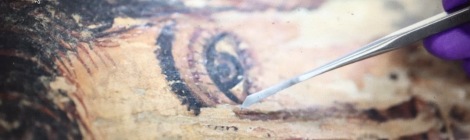
On Friday December 16th, I had the pleasure of assisting with the hyperspectral imaging of three paintings in the Cantor Arts Center’s collection, including Andre Derain’s Still Life With Fruit (1938),  Dirck van Delen’s Solomon Receiving the Queen of Sheba (1642), and Hieronymus Bosch’s The Last Judgment (1500s)Joyce Farrell and Torbjorn Skauli of the Stanford Center for Image Systems Engineering led the advanced imaging procedure, which employs a high-resolution MCT (mercury cadmium telluride) detector that produces digital, high-resolution true-color renderings, performs near-infra-red scans to uncover any underdrawings, and provides information about the pigmentation and other materials in the medium.  Both the Louvre and the National Gallery have also been using this system to study and photograph their collections. (See http://www.hyspex.no/pdfs/HySpex_Art_scanner_web.pdf.)

Curators, professors, conservators, and scientists collaborating at the Cantor Arts Center

What is hyperspectral imaging?  First developed for remote sensing applications, hyprspectral imaging collects information about a scene or an object from across the electromagnetic spectrum.  It is is a type of spectroscopy that collects information as a set of images. Each image represents a range of the electromagnetic spectrum, known as a spectral band.  Hyperspectral imaging deals with taking snapshots using narrow spectral bands over a continuous spectral range to produce a visual rendering of the spectra of all pixels in the scene.   To examine art, the hyperspectral imager gleans optical information  over visible (400-700nm) and near-infrared wavelength ranges (700nm to > 1micrometer), as some oils and pigments don’t fluoresce in the visible light range.  Because certain objects and materials leave unique fingerprints across the electromagnetic spectrum, the imaging technique has been applied in a multitude of ways in the fields of geology, agriculture, resource management, and medicine – to image faces, large fields, forested areas, and even pig organs.

Lubert Stryer, Professor of Cell Biology, pays a visit to the Cantor Arts Center

To measure the spectral data of the paintings, we needed two lights to shine onto the paintings, however this caused some concern when the lights began to raise the temperature of nearby paintings in the gallery above the recommended temperature of 72 degrees Farenheit.  By altering the height of the lamps and turning them off when not in use, we managed to avoid setting off any temperature alarms.

Holding a white board over the work to calibrate the light levels of the imager

The processing of these high-resolution, spatially-resolved data sets is rather complicated.  In fact, Brian Wandell and Joyce Farrell are teaching a class next quarter (http://white.stanford.edu/~brian/psy221/syllabus.html), and they hope some students from the class will be interested in analyzing the images.

Torbjorn collecting data using a portable computer

Does art want to be conserved?

June 30, 2011
by

Several months ago, WJT Mitchell from the University of Chicago delivered a lecture and a follow-up seminar at the Stanford art department which discussed part of his book: What Do Pictures Want?  In it, Mitchell speculates that the words idol, fetish and totem can be used to classify the entire spectrum of images: from the Mona Lisa to Ronald McDonald to your family’s holiday card.   While the historical and philosophical twists and turns of his argument go beyond the scope of this blog post, the gist of his talk is thought provoking for art conservation.  Indeed, I’ve been stewing over it for weeks now.  By categorizing all images within the ostensibly magical spectrum of idol, fetish and totem, by proxy Mitchell endows all art works with a degree of agency.  Intriguing!  In the practice of art conservation we are used to thinking about what all the different agents of art – the artist, the curator, the public, etc. – would want for the object’s material condition.  Very rarely – if ever – do  we  consider that the object itself might want something.

For instance, the word totem is derived from an American Indian word that means something like “member of my family” or “relative of mine.”  Given the great lengths we go to in order to care for Western paintings and sculptures and the outrage and sense of loss that occurs when a so-called masterpiece is destroyed, perhaps “member of my family” is a more accurate definition for such objects than “work of fine art.”

The words fetish and idol can be used in similar ways.  The former is traditionally defined as a object with magical properties while the latter implies a manifest, god-like entity.  While I usually think of them as describing a foreign culture or distant time, could they also apply to Western art objects?  Take the Poussin painting above as an example (the one on the far right).  Perhaps my belief in its ability to teach us about the past makes it more of a “fetish” than a work of “fine art”?  What is “fine art” anyway?  And exactly how and why is it so good at teaching us about the past?  It is after all an inanimate object that cannot actively teach anything in the literal sense of the word.  In other words, perhaps my belief in Western painting’s ability to teach has more to do with my belief in its magical properties than in its distinguished history.

One of the primary benefits of thinking through art conservation with this triad is precisely that it approaches the art object from a non-Western perspective.  It is very easy to assume that we know what art is and  what we are supposed to do with it: we display it, look at it, enjoy it, learn from it, etc.  And our conservation decisions stem from this understanding.  However, following Mitchell, I want to suggest that these thoughts wash over a dynamism that is potentially at work within every art object.  If art history has taught us anything in the past 50 years it is that the relationship between viewing subject and object viewed is far from static.

Such thought exercises are useful to art conservation because they help us elaborate our reasons and make us more aware of our actions.  Our museum setting rose out of a Western tradition and continues to be dominated by Western objects and ideas.  And if art conservation is to be a truly world wide practice we have to think through these exercises and honestly come to terms with them.  By doing so future conservators might readily ask: Does the object want to be conserved or do we want to conserve it?

Protecting Patina on “Large Torso: Arch”

May 4, 2011
by

Henry Moore’s “Large Torso: Arch” is one of the many bronze sculptures we have in the collection here at Stanford.  Like most bronzes, it has a chemical patina that was applied by the foundry that cast it: in this case, Noack Foundry in Berlin.  Moore chose to have his bronzes fabricated by Noack at least partly because of their patination abilities; indeed they are one of two foundries that cast the vast majority of his work.  For whatever reason, Moore judged Noack’s finishing techniques and their results to be appropriate for his sculpture.

One of the main obstacles conservators face is the mystery behind these techniques.  For the foundry, such secrets keep them in business; for the conservator, the fact that these details are kept a secret makes work difficult.  Even though you might be able to guess what was used to create a certain patina – Ferric Nitrate, Cupric Nitrate and Sulfurated Potash are all commonly used – the variables that contribute to the final appearance are endless.  For instance, the concentration of the solutions, the duration of application and the surface temperature of the bronze can all change the end result.  Conservators often solicit artists directly about their patination process so as to to anticipate potential future conservation needs.  While this has its advantages and has proven invaluable here at Stanford, its drawbacks are that opinions on patina often change and that people sometimes forget how a certain effect was produced or what the original parameters of production were.

"Large Torso: Arch" in the early 1970s

The lack of definite information about the exact chemicals used and the details of the patination process leaves conservators without a direct path to follow.  If they want to maintain the artist’s original intention throughout the years, they have to protect the mystery patina that is already there.  If it’s not protected the bronze will quickly corrode and the surface will begin to look more like it’s been covered in teal spray-paint than layer upon layer of subtle, chemically patinated color.  A common misunderstanding about bronzes is that the bright green corrosion that can develop over time is the patina.  In fact, the secret patinas of most foundries are almost always composed of layers of translucent color on top of each other: brown, green, black, and sometimes even blue, red and orange.  The combination of layers of colors like these builds up a surface that reacts to changing light conditions and highlights different areas of the surface.

Of course, the artist could express that they want the patina to corrode.  In fact, Henry Moore is known to have expressed this exact sentiment for certain sculptures.  However, it’s also known that he sometimes insisted on complete repatination because of a corrosion.  Moore’s fascination with and insistence upon the relationship between his sculptures and their environment supports this modifiable aesthetic.  He didn’t have a monolithic approach to maintaining his sculptures because he didn’t see them as isolated entities that could stand on their own, but rather as object that were deeply enmeshed in their environment.  In other words, the record seems to indicate that Moore’s opinion on patina depended upon the sculpture’s context.

"Large Torso: Arch" in 1998 before conservation

So the million dollar question is: what did Moore think of this particular cast in this particular location?  Unfortunately we do not have a definite answer.  However we do know that he liked the site and that he liked the appearance of the patina when it was originally installed.  So all we can do is try to preserve that appearance as best as we can.  This is why we apply a wax coating to the surface.  Otherwise, the patina would corrode entirely away.  This is also why we don’t apply a thicker, more protective and more opaque coating.  Because we know he like the sculpture as it looked when it was first installed.

"Large Torso: Arch" in 2003 after conservation

Johann Joaquim Winckelmann

March 24, 2011
by

I was excited to learn in Ivy’s recent post about her exhibition “True Colors” that Johann Joaquim Winckelmann was partially responsible for spreading the myth about the whiteness of ancient Greek sculpture.  With her exhibition as inspiration, I thought I might provide more details on why Winckelmann espoused this ideal of whiteness, and thus tie her post into my ongoing series of entries on the history of art restoration.

A portrait of Winckelmann by Raphael Mengs after 1755

Winckelmann was and continues to be a celebrated figure in the history of art because of his historicist method—most fully developed in “History of Ancient Art” of 1764.  In this work, Wincklemann not only provided the first comprehensive account of Greek sculpture but also argued that historical factors such as the climate and political freedom of ancient Greece were fundamental in producing its sculptures.  Simply put, this was the first text to argue that works of art were in some way produced by historical circumstances.  Given this widely held fact, it is unsurprising that Winckelmann is generally regarded as the father of art history.

However, Winckelmann’s legacy is complicated by the tradition out of which it emerged.  Mid-18th century Germany also gave rise to rationalist aesthetics; a philosophical school often exemplified by Alexander Baumgarten’s attempted formulation of a “science of the beautiful.”  Winckelmann attended Baumgarten’s lectures on aesthetics and at the very least was inculcated in his system of thought.  Thus, even though Winckelmann’s contextualist, historicist writing was in many ways directly at odds with Baumgarten’s universalizing, idealistic notions about beauty, he did not completely escape the dominant intellectual mode of his time.

Thus, as Ivy pointed out, Winckelmann still held idealist notions about art.  While he contextualized to some extent, he also famously argued that the “noble simplicity and quiet grandeur” of Greek sculpture made it great; this is perhaps why he preferred marble sculpture to be white.  Indeed, a white sculpture is certainly more “simple” and “quiet” than the polychrome ones we know about today.  Thus, the great irony of his legacy—and the one that  “True Colors” best exemplifies—is that while he is remembered today as the father of art history, the idealist components of his writings also led to the whitewashing and destruction of much of that history.  In other words, his writing had two contradictory effects.  He simultaneously inspired an historicist approach to art objects—one that eventually led to the professionalization of art history and subsequently the professionalization of art conservation—and he inspired an idealistic myth that the whiteness of Greek marble made it great—which led to the whitewashing and the removal of historical evidence about Greek sculpture.

The paradox of Winkelmann’s legacy is a fascinating instance of how the ideals of art and the facts of art come into conflict.  While we all  like to think that we are on the side of fact—especially when it comes to art restoration—the slope between fact and ideal is slippery at best.  (See my previous post on keeping art looking “good”)  But don’t just take my word for it . . . visit “True Colors” and see the facts for yourself.

True Colors: Trends in Conservation

March 17, 2011

By Ivy Nguyen, class of 2013.Cantor Arts Center Conservation Lab

In front of the Conservation Lab we have three signs with the following words and their definitions:

Conservation: Conservation is the deliberate alteration of the chemical and/or physical aspects of cultural property, primarily to stabilize it and to prolong its existence.

Preservation: Preservation is the protection of cultural property against deterioration and damage by providing preventative care:

  • regulating environmental conditions
  • practicing sound handling and maintenance procedures for storage, exhibition, packing and transport
  • controlling pests
  • preparing for emergencies

Restoration: Restoration involves treatment procedures that are intended to return cultural property to a known or assumed state—for example, near to its original appearance—often through the addition of non-original material. In current restoration practice, all additions are fully removable.

The collection and stewardship of art involves a complex interplay between these three different goals. While the distinction between these three areas seems subtle, different combinations of these goals will ultimately determine how the object is treated to maintain it for future generations.

This interplay between conservation, preservation, and restoration has varied—sometimes dramatically—over time. One infamous case in the area of Greco-Roman marble sculpture—the Vatican collections—represents this evolution well.

The Vatican’s story was briefly alluded to in the “True Colors” exhibition. Long a major collector of fine art, its collections were headed in the 18th century by Johann Joaquim Winckelmann, who published the influential “Thoughts on the Imitation of Greek Works in Painting and Sculpture” in 1755. In this book, Winckelmann stated that the best marble sculpture should be white, which led to a systematic scrubbing of many pieces in the collection and set the standard for others to follow.

Since much of this work rests on how “good” the object is made to look, the practice of caring for these objects is also inextricably tied to changing tastes. One great example of how differing tastes guide the hand of those who care for art objects is the case of the Hope Hygieia, which is now at the Getty Museum. When the sculpture was uncovered in 1797, it was popular practice to restore such broken ancient sculptures by reconstructing missing parts in marble and attaching those pieces to the original sculpture. In the 1970s, however, the prevailing museum aesthetic was to display these pieces as they were found—any modern restoration was considered a falsification of the truth. As such, many restorations—including the Hope Hygieia’s—were removed.

Thirty years later, conservators and curators are beginning to appreciate these reconstruction attempts as intrinsic to the object’s history and worked to restore the reconstructed pieces of the sculpture, which had been saved when they were removed. A more detailed history of the sculpture can be found at the Getty’s website (http://www.getty.edu/art/exhibitions/hope_hygieia/).

These restorations of the reconstruction were done using easily identifiable and reversible methods, which reflects the current trend in museum practice. And although the balance between restoration, conservation, and preservation remain in flux, that balance also means that you will not be seeing original sculptures repainted anytime soon.

Join in on the conversation: should we attempt to restore works of art to their original state, or are the changes throughout history just as important?  What do you think about performing a restoration as opposed to leaving or improving an old one?  What other ways museums might illustrate or perform these changes based on new technologies?

Casey, Christopher (October 30, 2008). “”Grecian Grandeurs and the Rude Wasting of Old Time”: Britain, the Elgin Marbles, and Post-Revolutionary Hellenism”.Foundations. Volume III, Number 1http://ww2.jhu.edu/foundations/?p=8.

Maintaining The Gates of Hell

February 10, 2011

By Ellen Bechtol

This being my first blog post, I find it appropriate to introduce myself.  I joined the Outdoor Sculpture Crew in November 2010 and I’m currently completing a graduate degree in Museum Studies at John F. Kennedy University.  After graduating from William and Mary, I moved to Palo Alto a couple of years ago.  Besides working with Oliver, I also volunteer at the Cantor Arts Center, helping to update the museum’s exhibition records.  I hope you find this post informative, thanks for reading!

Over the past few weeks, Oliver and I have been performing routine maintenance on the Rodin Sculpture Garden.  Last Thursday we tackled the largest piece in the Garden, The Gates of Hell.  While working on The Gates, several visitors approached us to ask what we were doing to the sculpture; this post explains how we maintain most of the bronze sculptures in the Outdoor Sculpture Collection.

Buffing the wax with nylon bristle brushes

By regularly cleaning, inspecting, and waxing the outdoor sculptures, we hope to prevent the need for more invasive conservation work in the future.  To clean the bronze, we initially spray it from the top down with water to soften and remove the top layer of dust, grime and bird droppings.  Then we look to see whether or not the water beads on the sculpture’s surface.  In areas where water does not bead, the previous wax treatment has worn off.  Next the sculpture is washed with a mild soap using soft sponges and brushes and then rinsed clean.  Following that, we use absorbent towels to dry the sculpture thoroughly.  It is important that the sculpture be completely dry and warm before applying wax to ease application.  Once we are sure that the sculpture is dry and the sun has gently heated its surface, we apply a hard, high melting point microcrystalline wax called Be Square 175—the number 175 refers to the melting point of the wax in degrees Fahrenheit.  Mineral spiritsa mild solvent often used as a paint thinneris added to the wax in order to produce a thin fluid which can be readily applied to the sculpture.  When the wax has dried, we buff it twice, first with large nylon brushes, and then with a piece of fine nylon stocking.  Buffing compresses the wax into a thin, hard film, providing lasting protection, a shine to the sculpture’s surface, and a richness to the color.

The sculptures in the Rodin Sculpture Garden are cleaned every other month with wax treatments applied as needed, generally twice a year.